Bulletproof, knife-proof ...

Kinetic energy, bulletproof, knifeproof or syringeproof...everyone knows what a bulletproof vest is. But on what physical principle does a "fabric" or a rigid plate stop a bullet or a knife and what is the material that shields you from a penetrating object? What ergonomics, what weight and what benefit/risk ratio is there for the user? What is the (optimal) life span of the protective material? In short, here's a little overview to help you choose the right protection and take into account the constraints that go with it!

Let's start by defining the basics (for those of you who don't like it, go to the next part of the article) - what is kinetic energy? Let's make it simple and brief.

  • It is the energy of a moving body (in this case the bullet, the knife or the syringe). This energy will depend on the mass of the body in question, and its speed. The kinetic energy is measured in joules. In the case of a bullet - which will be the simplest and most meaningful example - it is the kinetic energy released that determines its penetration power (along with a set of other factors such as the caliber of the bullet, its shape, its material, the power of the explosion that will allow the initial force to be imparted - setting the bullet in motion, and the length of the barrel - which will allow the energy to be accumulated up to the muzzle).
  • To calculate the kinetic energy of a bullet (or of another object) it will be necessary to apply the following formula:
  • Ec = 0,5 × m × v 2
  • Ec: Kinetic energy
  • m: mass - in kg
  • v: speed (squared) - in meters (per second, minute, etc.)
    • So for a 9x19mm bullet, with a weight of 8 grams (0,008 Kg) and projected at a speed of 350 m / s it gives:
      • 0,5 × 0,008 (the mass expressed in Kg): 0,004
      • 350 × 350 (the squared speed of the ball in m / s): 122500
      • So: 0,004 × 122500: 490 joules
  • The fascinating thing about energy is that it cannot be lost, but only transferred. Once out of the barrel - and therefore once in the air - the energy of a bullet is subject to friction (by stretching the air) and therefore transfers part of it to the bullet, until it hits its target. At the impact, the remaining energy will be transferred in its entirety (depending obviously on the nature of the target) and will cause the damage that happens to the tissues, the bones, the organs...This is where the bulletproof material will do the job!

The general idea is to absorb (stop the projectile, it's tempting but... you remember that the energy is not lost, it's simply transferred - I'll let you imagine where it would go if the protective material stopped the projectile without absorbing the energy...) the transfer of energy from the projectile to a surface (the largest possible) other than your body. Where it gets complicated is that the tip of a knife or the cone of a bullet have relatively "small" surfaces on impact while concentrating massive energy!

kinetic energy comparison

Ballistic Steel, Kevlar, Goldflex, polyethylene, dyneema, ceramic...Before presenting the mechanical properties of the protection materials, a small list of those used in all the vests of the market (I intentionally leave aside the materials resulting from nanotechnologies, the biosteel - the famous spider silks - or the cellular modifications of the artist Jalila Essaïdi) :

  • Fibers (available in flexible sheets):
    • The para-aramids
      • Twaron (Teijin company)
      • Kevlar (Dupont company)
      • Goldflex (Honeywell company)
    • Polyethylenes
      • Spectra (Honeywell company)
      • Dyneema (DSM company)

Of all these fibers, Goldflex (increased strength, optimal torsional behavior - more expensive to produce) and Dyneema (higher weight/strength ratio than its competitors and remarkable resistance to moisture, abrasion and UV) stand out.

Here again we skip the manufacturing process and the different stages of processing of the fibers, the weaves used, as well as the physical properties of each material or their variations (for your information there are 6 different types of Kevlar, not counting the types of Dyneema, obtained according to a different manufacturing protocol - I do not have enough time to write a book... But if you are interested, send us a message, we will send you the documents)

You will find one of these fibers in all the flexible panels currently available on the market. They have more or less the same mechanical capacities - absorption capacity in joules per m2 - with variations when it comes to resistance to humidity, UV exposure and abrasion. Obviously, some will be "better" than others, but in any case, it should be considered that a damaged plate (following the absorption of a shot, an exposure to a chemical agent, a tear...) must imperatively be replaced.

ballistic fiber dyneema

  • Steels ( in either hard plates or specialised cutouts for vehicle or building protection):
    • Armor or Armox 500 - depending on the manufacturer
      • Without going into details - a steel with a specific structure, used for the manufacture of hard ballistic plates and bullet-proof structures for vehicles, modular buildings... Available in variable thicknesses according to the need.
      • The 500 indication refers to the hardness index (Brinell scale)
      • Steels with an index of 550 or higher are not used for the manufacture of personal protective equipment.
  • Ceramic - or rather a composite material including ceramic (available in hard plates or in marbles, exclusively for bulletproof use):
  • Composed mostly of a first layer of epoxy or fiberglass - protection of the plate against splinters, scratches, blunt shocks ... - ceramic (alumina, boron carbide ...), then layers of polyethylene UHMWPE (ultra high molecular weight polyethylene) or a flexible ballistic fiber (see above) which will ensure the dispersion of energy on the entire surface of the plate. This is what gives us the famous SAPI (Small Arms Protective Insert) ballistic plate.
  • The three ceramic compounds used (most commonly) to make a ballistic protection plate:
    • Aluminum oxide (Al2O3 - commonly known as Alumina)
      • It is the most economical formula (in terms of manufacturing cost and volume of material to be used to obtain an optimal level of protection) and the one with the highest density - depending on the purity of the final product - its manufacturing process must have a purity of 90 to 99,95% and a porosity below 2%
    • Boron carbide (B4C)
      • 2 times harder than alumina, but also with a lower density, it is the ideal material to "stop" a bullet...except that it is expensive to produce, extremely brittle when "torn" - which is the feature of an armor-piercing bullet for example - and that it requires a different manufacturing process depending on whether one wants to obtain optimal protection for the absorption of a single bullet or several. To exploit its exceptional performance, boron carbide is generally used in conjunction with silicon carbide.
    • Silicon carbide (SiC)
      • It has, roughly speaking, the same physical capabilities as boron carbide, but with a higher density. The combination of a hardness almost similar to alumina and boron carbide with its density - depending on the manufacturing process - more or less high, make it the ideal choice for (or rather against) very high speed or armor-piercing bullets.
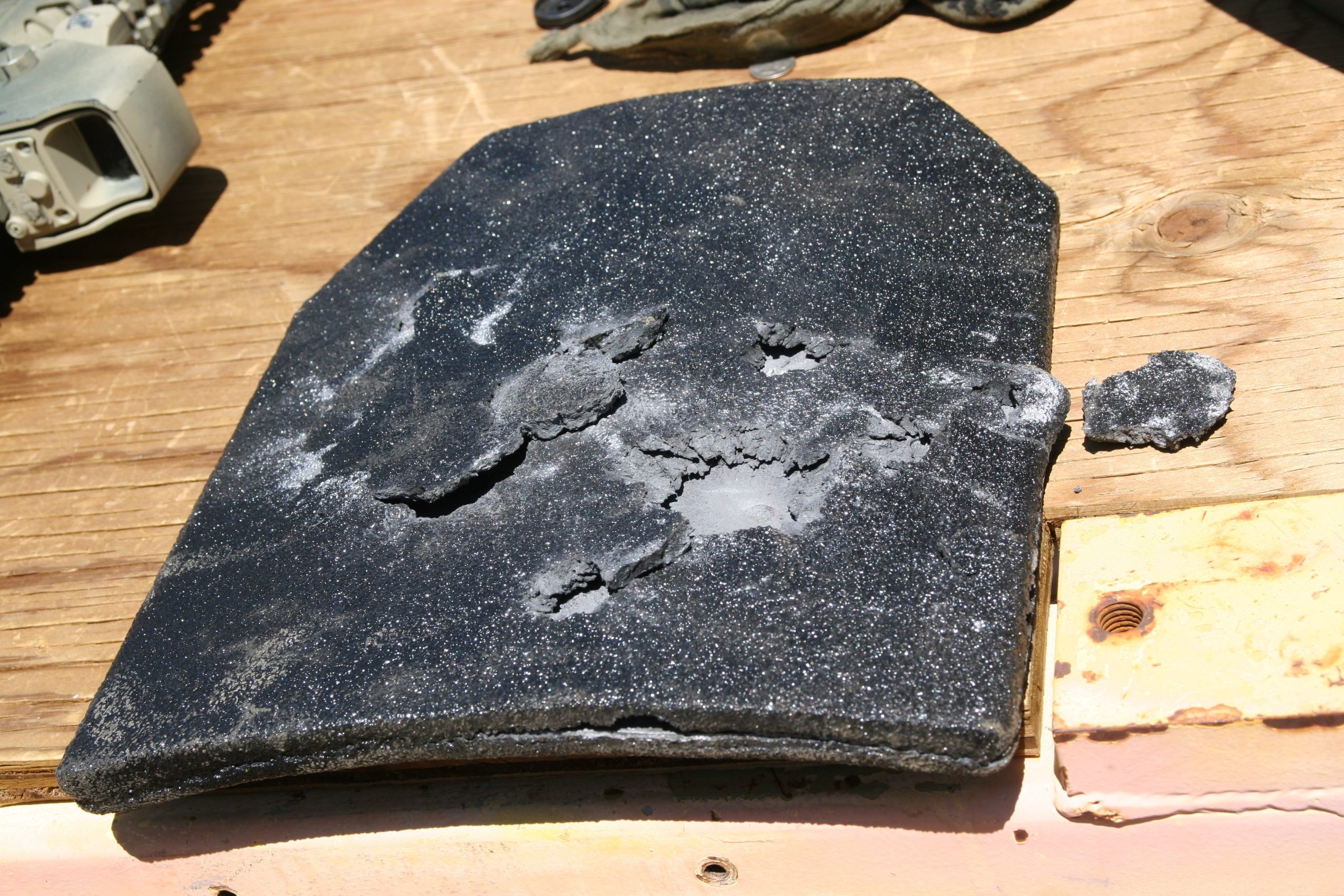
    • It should be noted that the ceramic component, by nature, is "brittle" and the ceramic protection plate will invariably suffer significant damage on impact - indeed, it is part of what ensures the transfer of energy and the stopping of the projectile. We will discuss the difference between "single" and "multi" hit plate(a plate that has the ability to absorb the energy of a single or multiple projectiles), but as noted in the introduction to the "ceramic" chapter, ensuring the consistency of the material, allowing it to retain its ballistic properties, and avoiding shrapnel projection, is achieved by adding a composite material (covering - epoxy, carbon fiber polyester resins) and a ballistic material (based on polyethylene or aramid fiber for example - allowing the reduction of microcracks in the ceramic plate and an optimal absorption of the kinetic energy). Most ceramic plates also have a layer of material (phenolic foam) for its fire resistance and thermal insulation properties.

Simply put, the stiffer the ceramic plate (and made in conjunction with a "blanket" and "reinforced" with a ballistic fiber), the "harder" the ceramic used - harder than the bullet material - the better!

  • High performance polyethylene (UHMWPE - ultra high molecular weight polyethylene) in its laminated composite form (in its fiber version, UHMWPE is - in particular - the ballistic protection materials Dyneema and Spectra in the form of flexible ballistic plates) - again the material will be used in the form of individual plates or cut to size for the protection of vehicles or aircraft. Let's make it simple: to date it is the most resistant thermoplastic compound (to shocks, solvents, abrasion) and it hardly absorbs humidity. Composed of a series of repeated monomer units (basically the repetition of the structure of a macromolecule - thousands of times. Polymerization), UHMWPE can be manufactured using several processes (with the use of a thermostatic matrix, with a higher or lower number of filaments or a larger or smaller cross-section, with a particular spinning process...) and the protective sheet can have a variable number of sheets (the UHMWPE "sheet" manufactured by DSM Dyneema® SB71, for example), but in the case of a hard sheet it will always be presented in composite form. Its very low density and exceptional strength make it the ideal material for an optimal protection/weight ratio.
  • You will find the UHMWPE in the composition of most ballistic shields and visors - especially because it allows transparency and therefore an optimal vision for the wearer.
  • A UHMWPE plate will not be able to be used for protection against an armor-piercing or high velocity bullet (a bunch of tests have shown this) but will be an excellent additive to the ceramic plate to allow for a sort of individual "sandwich" plate - the ceramic and composite plate as presented above - that will provide protection against most light calibers (excluding some specific ammunition, .50 BMG, .408 CheyTac, basically any anti-material caliber).

ceramic arrangement

Great ! So how does it actually work? Relatively simple! whether it is a fiber, steel or ceramic, the important thing is:

  1. That the molecular structure of the material has a maximum energy absorption capacity.
  2. That the absorption of energy is done on the widest possible surface.
  3. In the case of a bullet-proof vest, the force of the impact on the protective material allows the deformation (and thus reduces the energy concentration by allowing the bullet to expand) or the burst of the projectile.

For the proposed "soft" protective materials (kevlar, goldflex, spectra or dyneema):

For the sake of simplicity, I have deliberately left out the structural differences between para-aramids and polyethylene. Let's imagine a tennis court net (or the net of a soccer field goal). When a ball hits the net, it deforms conically and the strings that make up the net absorb the energy at 360° until it is completely absorbed and the ball stops. The "soft" textile material of a bulletproof plate will act in exactly the same way, except that the trauma caused by a very powerful conical penetration - and over a very small area - to the inside of the body can be just as deadly as if the projectile actually penetrated the body. The difference lies in the fact that the mesh of the fiber is much tighter than the mesh of a sports net. This very fine mesh will allow the energy to be dispersed over the entire surface of the plate and thus reduce the conical deformation imposed on it by the projectile (we will come back to this in the chapter on the various official standards).

To allow this dispersion of energy and the complete stopping of the projectile before penetration, it is necessary that:

  • The layers of textiles that act individually as a net
  • A mesh of each layer that is fine enough for maximum energy dispersion over its entire surface
  • That on impact the energy transfer acts on the projectile itself by "crushing" it to eliminate part of the penetration due to the conical shape of the bullets - and thus by contributing to increase the surface of the bullet's "grip
  • That the fiber used has exceptional tensile strength properties
  • The specific case of knife or syringe guard plates:
  • The difference in velocity (speed) of a stab with a knife (or a spike, or a syringe) is much lower than that of a bullet (even of very small caliber). As a result, manufacturers (the first standardization of anti-knife plates dates back to...1993) have had to adapt the mechanical resistance of the fibers usually used to stop bullets.
  • The fibers used have the same commercial names - Dyneema or Kevlar - but the manufacturing process differs to obtain a mesh capable of absorbing and stopping the progression of a blade or syringe in the surface of the plate.
  • We will come back to this later but it is the English (damn roast beef) that have (in 1993), via the HOSDB (Home Office Scientific Development Branch - the scientific institute of the Ministry of the Interior what) developed a specific standard designed for protection against knife blades or syringes (ballistic capabilities, test protocol, efficiency levels, etc.)
  • It is noted that a knife guard plate may be worn in conjunction with a bullet-proof plate

For proposed "hard" protective materials (ceramics & UHMWPE):

The process is slightly different! The purpose of a hard plate is to protect the wearer from the mechanical damage of a much faster bullet (potentially designed for increased penetration or concentration of kinetic energy on a small area). The behavior of a "smaller" caliber bullet (or one with a smaller initial explosion) upon impact with a "textile" plate will not be at all identical to that of a faster, more "powerful" bullet. On the one hand, because the kinetic energy released could allow the projectile to penetrate the protective surface without any problem - and continue its trajectory through the wearer's body - and on the other hand, because even in the case of energy absorption, the conical deformation imposed mechanically would cause injuries that could be just as deadly as if there were no protection at all. It is therefore imperative that the hard plate:

  • is made of a harder material than the one facing it (the bullet that tries to penetrate)
  • that the energy absorption is done (as for the flexible plates) on a surface as large as possible
  • that on impact (always as for flexible plates) the projectile crushes or disintegrates to the greatest extent possible
  • The particular case of "multi-hit plates" (the plate able to absorb the energy of several projectiles in a row):
  • Nothing very complicated - please refer to the chapter "Ceramics - or rather a composite material including ceramics" which details the structure of a plate consisting of different layers (protective coating - epoxy, ceramic, composite ballistic material and potentially a layer of phenolic foam).
  • It is this "sandwich" composition that will allow to keep mainly the properties of the ceramic (which, as indicated above, will fragment at the first impact). Even in "piece" the ceramic material, as long as the "sandwich" design keeps its initial structure - in two words the ceramic in piece remains compressed in its gangue (before the first impact), will keep its mechanical properties. The composite ballistic material will continue to perform its role as an energy absorber.
  • In addition to the "sandwich" composition, the type of structure used for the ceramic surface is also important. According to the tests mentioned below, it is essential that the ceramic is not laid in one piece but in several "tiles". This tiling allows to keep intact the protection capacities of the tiles adjacent to the tile that absorbed the first impact. Logical.
  • Based on a V50 (velocity 50 - see below) comparison test performed by Messrs Horsfall and Buckley and Watson et al (google it if their tests are of interest to you) with intact and impacted plates, the result indicates (depending on bullet velocity at impact / with 7,62 ammunition / on SAPI alumina plates) a decrease in performance from 3 to 8%. This still shows that the material retains a capacity of 24 to 12% above the requirements of the standard.
  • Please note: even if the material does the job, it won't be able to protect you against dozens of impacts! In two words, take cover!
  • The special case of "stand-alone" plates - that provide the level of protection without being used in conjunction with another (flexible) protective plate:
  • Again, this is a (hard) protective plate that has been manufactured or structured in such a way that it can be used on its own, without being worn in conjunction with a soft plate (typically a protective plate worn in a vest AND a hard plate worn over it in a compartment provided for this purpose). In short, you can use this plate in a tactical "plate carrier" - this will reduce the volume and weight of the vest with soft plate + hard plate combination as well as the wearer's comfort of movement. Obviously this also reduces the surface protection, but if you're pretty sure you're going to face shots of more powerful calibers than those " covered " by a soft plate...you might as well not bother - just think of the risk of shrapnel...
  • The "anti-trauma" plate:
  • Simple: it is an additional flexible plate (usually made of fiber, but it has existed in steel or aluminum) that is packaged in a much thinner format than the classic bulletproof flexible plate (but in the same material). The idea is not to offer "additional" protection but to limit the conical deformation on impact (and the resulting physiological trauma) by optimizing the energy dispersion surface and the crushing of the projectile on impact.

But then what type of plates stops what type of calibers or shrapnel?

Each industrialized country - France, USA, Germany, China, Russia, England...has defined, at one time or another, a test protocol that defines the protection capacities (for shrapnel, ammunition, blast effect and knives) of each material used. The different protocols all propose (according to the constraints required for the tests) a scale that allows to determine which product is the most adapted to the risk that we want to cover.

Well, let's start at home, eh? It's the least we can do! The French protocol and assessment scale therefore:

  • Well, there is a slight problem: the AFNOR (Association Française de Normalisation) does not offer a specific protocol for bulletproof materials used for personal protection or on vehicles
  • Note, however:
    • NF A36-800-2 and NF A50-800-2 standards (Hot-rolled weldable steel sheets for shielding - Part 2: fire test method)
    • The standard NF P 78-401 (replaced by the European standard EN 1063 - Glass in building - Safety glazing - Testing and classification of resistance to attack by bullet
    • The NF EN 1522 / 1523 standard (Windows, doors, closures and blinds - Bulletproof - Prescriptions and classification)
    • In short, no comment ...

The American protocol and rating scale:

  • You all know the standard set by the NIJ. But the Yanks like to do things in a big way! This gives :
  1. The standards defined by the NIJ (National Institute of Justice - the US federal scientific research and standards body):

NIJ Standard 0101.07 - Ballistic Resistance (draft)
NIJ Standard 0101.06 - Ballistic Resistance
NIJ Standard 2005 Interim Requirements for Ballistic Resistance
NIJ Standard 0101.04 - Ballistic Resistance
NIJ Standard 0101.04 Revision A - Ballistic Resistance
NIJ Standard 0101.03 - Ballistic Resistance
NIJ Standard 0115.00 - Stab Resistance
NIJ 0104.02 Standard - Riot Helmets and Face Shields
NIJ Standard 010600 - Helmets
NIJ Standard 0117.00 - Public Safety Bomb Suit Standard
NIJ Standard 0108.01 - Ballistic Protective Materials
FBI body armor 2008 test protocol
HP White 401-01b Helmet Testing Procedure

  1. The standards defined by the US military:

MIL-STD-662F, STANDARD MILITARY: V50 BALLISTIC TEST FOR ARMOR

The German protocol and rating scale:

  • With my apologies, it is impossible to find a version of the documents in French or English, so I give you the original version in German - you still have to use google translate huh...
  1. The German certification body (Vereinigung der Prüfstellen für angriffshemmende Materialien und Konstruktionen) defined the following standards:

VPAM KDIW2004 Stand: 18.05.2011
VPAM KDIW 2004 Stand: 12.05.2010
VPAM HVN 2009 Booth: 12.05.2010
VPAM APR 2006 Edition: 2009-05-14
VPAM BSW 2006 Stand: 14.05.2009

The Russian protocol and rating scale:

  • The GOST (for those interested in a translation of the document send me a message, we know how to do it internally).

GOST R 50744 95

The English protocol and assessment scale:

  • We recall that the English scientific institute was the first to define a specific protocol for materials manufactured for protection against knives and syringes in 2013.
  1. English certification body - HOSDB (Home Office Scientific Development Branch) defined the following protocols:

HOSDB Body Armor Standards for UK Police (2007)
HOSDB Body Armor Standards for UK Police (2007) 1 Part: General Requirements
HOSDB Body Armor Standards for UK Police (2007) Part 2: Ballistic Resistance
HOSDB Body Armor Standards for UK Police (2007) Part 3: Knife and Spike Resistance

The Chinese protocol and assessment scale:

  • For the full document, please contact us (paid document).
  1. The standard is defined under the name:

GA 141 2010

NATO Protocol and Rating Scale (STANAG) - for vehicles and aircraft exclusively:

  • This protocol is expressed in 3 volumes (NATO AEP-55 STANAG 4569 vol 1, vol 2 & vol 3)
  • It is not intended for personal protection elements but exclusively for vehicles and aircraft
  1. The table of the standard is available here:

NATO AEP-55 STANAG 4569

Australia and New Zealand protocol and rating scale:

  • It should be noted that this protocol only takes into account handguns and hunting caliber .12
  1. The standard is defined under the name:

AS / NZS 2343: 1997

HERE A SUMMARY TABLE OF STANDARDS FOR INDIVIDUAL PROTECTIONS AND PROTECTIONS FOR VEHICLES AND AIRCRAFT

LITTLE TIPS BEFORE (AND AFTER) PURCHASE:

  • Think about mobility and comfort of movement - to be stationary under enemy fire is to be dead
  • No protective material guarantees you that a projectile will not penetrate. Have confidence in your material but in a reasoned way, do not expose yourself in a useless way
  • When a plate (flexible or rigid) has undergone an impact or significant degradation ... it is no longer functional!
  • When you evaluate the weight of your vest or your plates, take into account the weight of your bag, your ammunition, your weapons...
  • Buy "anti-trauma" plates. The cost is lower and in any case less than the pain and the consequent lethal risk of injuries caused by the internal deformation of your flexible plates on impact.
  • Remember that the effectiveness of materials has a lifespan! Beyond the warranty provided by the seller or the manufacturer, you must consider that the material is no longer functional
  • Observe the maintenance and protection instructions (humidity, UV exposure, exposure to solvents, etc.) indicated by the seller or the manufacturer
  • Practice handling your weapons and the accessories you carry with your vest or your plate holder on your back! It will improve your sensations as your reflexes

Good luck, and as always, stay safe, be blessed!

Autonomy, articulation & adaptivity of the combat group

How to organize and implement the different missions of a group of combatants? How does the group leader define the objectives and protocols to be applied? How can a group or a pair of isolated fighters ensure its autonomy and remain proactive, even when separated from its leaders and its base? We will discover (and for some rediscover) the fundamental actions of the fighter in direct contact with the enemy, through a simple explanatory & a set of diagrams (coordination, articulation, reflex actions, various commands ...).

In addition to the technical aspect of the document and the presentation of a set of diagrams that will allow you to have at hand a useful "memo" that can be adapted to the different scenarios you may be confronted with, this extract from the TTA 150 (published by the French armies) is intended to be a perfect basis for establishing the training scheme for combatants (from the soldier to the group leader), to inculcate in him the basics of infantry, and, more generally, to make him aware of his quality as a warrior.
In the introduction, a reminder of the "obligations" (in quotation marks, since a warrior's accomplishment and his ability to go the distance is a combination of factors) of the combatant and his leader. It is interesting to note that a small paragraph includes the obligations agreed to by France under the Geneva Conventions (even if the framework of a civil conflict on its own territory does not easily lend itself to the respect of the obligations in question).
The three following chapters indicate (and differentiate) the "reflex acts", the "elementary acts" and the main missions of the pairs. It is in this section (modest in volume) that the trainers will be concentrating the first modules of the training scheme, with in particular :
  • Move, position yourself & use your weapons
  • Navigate in time and space
  • Provide intelligence and keep in touch with his boss and base
  • Shelter, hide and hide
  • Defend yourself, secure a point or area
  • Cross the lights and keep the fire rolling
Then come the "good practices" and the basic protocols that allow the command of a team, a group (a group being a set of teams - from 2 to 4) or a section. We skip the intrinsic qualities of a leader to focus on one of the major aspects of an optimal group: its mobility and its capacity to be autonomous (in its decisions at the tactical level, in its logistic support...). The emphasis is put (with diagrams) on one of the main missions of a group, the patrol. How to ensure the movement of men, how to modify it according to the imperatives of the ground or the detection of hostile elements, how to ensure an effective and simple chain of command...
The specific features of CBRN or anti-aircraft (which are discussed in the document) are not essential concerns of a constituted militia that does not have the resources of a national army, either in terms of logistics or in terms of reaction capacity. Nevertheless, the recommendations of this document can be transposed through the prism of technologies and chemical or biological elements that would inevitably be used in case of a collapse of normal life: drones, IEDs, weed killers, improvised incendiary bombs... And train the men to take into account this type of threat. Moreover, this type of risk reminds us of a key element: a hostile is a hostile, it is essential not to underestimate a force that is opposed to you.

Logistics! We already approached this absolute, this graal of any combatant, without which nothing is conceivable. Generally articulated and implemented at a higher level, the configuration of a militia engaged in a civil conflict must make of it the principal concern (after the combat in itself) of the leader of "section" - or of the constituted group which approaches in volume a section. Each action must be subject to a PRELIMINARY control of the means implemented, according to:
  • Expected duration of mission before return to base
  • The type of mission - and therefore the risk potential
  • Physical constraints suffered by the group
  • Of the "comfort margin" that it is reasonable to take
  • And of course the nature of the land borrowed
The end of the document presents a very interesting scheme: "low intensity" combat in the crisis phase - that is, after civil peace and before a total collapse of normality, with a technical approach to the search, the checkpoint & the control. This type of "police" work refers us to the works of Colonel Trinquier and Captain Galula (to be read for latecomers and reread for those who have forgotten).
In short, security, reconnaissance, logistics, defense, area interdiction, the chain of command, the ability to be autonomous... Enjoy your reading!

TTA 150 / EXTRACT NO° 4 - BASIC COMBAT TRAINING - CLICK TO DOWNLOAD

STAY SAFE, BE BÉNIS!

What is Night Vision?

Seeing day and night, driving with all lights off, or detecting a movement out of reach of your vision in any weather? Yes, we will talk about night vision optics, define how this technology can exist, describe how it works and how it has evolved since its creation, and finally discuss its various possible uses (and their limits). By definition, the purchase of a night vision goggle is an investment. The product (telescope, binocular, binocular...) must correspond to the most versatile use possible, at the best cost, with the best possible life span.

Why can't a human being see at night?

Well, we exclude vampires and other werewolves, they are separate cases. The human eye is made up of two types of cells (the photoreceptors which line the bottom of the retina):

  • Cones - to distinguish colors

  • Rods - to set the brightness

When the level of luminosity decreases, only the rods - 1000 times more sensitive than the cones and with a number of 92 to 100 million/per human being (compared to the cat - 150 million approximately and which is nyctalope) - react. This explains why your vision switches to "black & white" mode. Also objects appear "blurred" because the transmission of photoreceptors to the optic nerve is less efficient with rods. Basically, in order to activate the natural "night vision" capacity and let the residual light pass through, the pupil widens and "activates" the rods. But with a limit that does not allow an efficient night vision.

Cells processing light in your eye:
cells of the treatment of light in the human eye

What is the Infra-Red?

It happens at the atomic level! An atom (made up of neutrons, protons and a "cloud" of electrons - that's the part we're interested in - that are in motion around the nucleus of the atom) is in perpetual motion, even in a solid body (an object). Depending on its level of energization (depending on the energy that is applied to it - and that it absorbs, such as heat for example) its electrons will move from a "passive" state to an "excited" state and away from the nucleus to an orbit of higher energy. The excited electrons (which gain an energy higher than their capacities) will, after a certain time, join their "natural" orbit around the core. This "jump" between two orbits will generate an electromagnetic disturbance (a radiation), and "release" this surplus of energy (which will be equal to the absorbed energy) in the form of photons (and of an electromagnetic wave - according to the principle of the wave-corpuscle duality). This release, in the form of waves AND photons, is quantified by the electromagnetic spectrum (to make it simple we will express it in metric system).

1 atom, its nucleus and its electrons (the circles around the nucleus are the 3 orbits "used" by the electrons, according to their state of excitation)
1 atom and its electrons
  • INFRA RED WAVELENGHT RANGES FROM 0,7 to 100 μm
  • VISIBLE WAVELENGHT RANGE from 0,38 to 0,7 μm
  • GAMMA, X, ULTRAVIOLET and RADIO RAYS, no interest here

What interests us for the technology used in night and thermal vision is the infrared wave range, divided (by the CIE system) into 4 spectral bands:

  • Near infrared: from 7μm to 1,6μm
  • Mid-infrared: from 1,6 μm to 4 μm
  • Thermal infrared: from 4 μm to 15 μm
  • Far infrared: from 15 μm to 100 μm

It is thanks to these different ranges of waves that your remote control, your LED lamp, the missile guidance, the thermal cameras, the lasers...and a lot of other applications work!

 The electromagnetic spectrum

the electromagnetic spectrum

What is residual light?

Absolutely essential to the functioning of your optical system (without residual light - and therefore without photons, no night vision possible), emitted by the sun, the moon, the stars - and all the light sources found in urban areas (public lighting, vehicle headlights, illuminated signs) which form a luminous halo over a vast area - residual light is the set of photons that wander over the space in which you are (at the speed of light by the way), day and night. It is by amplifying this light (obviously at night for a night vision) with the help of a photocathode and a phosphorescent screen that we will restore an image (of more or less good quality depending on the "generation" of the tube which contains the photocathode).

Now that the physical principle that allows the "night vision" technology is laid, we will be able to explain how it works!

How does a night vision telescope work?

As seen above, the basic principle (for a passively operated scope) is to amplify the residual light as much as possible to give the best possible image definition and brightness. I will only briefly discuss (and in the chapter "infra-red torch") the use of infra-red in an active way, this technology being potentially dangerous in tactical use.

  1. A lens (at the front of the goggles) captures the residual light and part of the near infrared spectrum and directs it to the electron tube (a photomultiplier).
  1. When passing through the photomultiplier, the light (photons) strikes a photocathode and generates electrons by photoelectric effect.
  1. The electrons are projected towards a wafer - polarized by electrodes - of microchannels, the MCP (which is considered as a photomultiplier wafer). The MCP is designed to facilitate the collision (each microchannel is oriented at a more or less important angle - from 5 to 8°) and to reduce the "noise". When the initial electrons penetrate the microchannels, they hit the walls and cause the emission of other electrons, which, by amplification, will in turn hit the walls of the microchannels, thus creating other electrons.
  1. The electrons (now numbering several thousand) will pass through a phosphorescent screen. Thanks to the kinetic energy acquired, the electrons ( which have retained the structure of the initial photons - which will allow the restitution of the image) will excite the phosphorus atoms...which will release photons. This light, when passed through a lens, will constitute the final image - which you will see "in green" because of the properties of phosphorus. The lens will have to allow the focus (and possibly the magnification) for the best possible quality.
    1. It should be noted that the "green" vision is due to the choice by the manufacturers of a specific phosphor - the human eye being more sensitive to green, it was the solution for a (more or less) optimal contrast at a controlled cost.

The schematic of a night vision goggle operation (2 generation+)

diagram of the operation of a night vision telescope

But then why are there different "qualities" of night vision goggles?

As with any human invention, there will be a continual effort to improve the capability of a technology. Through physics, biology or chemistry, through user experience, and simply through the ability to manufacture parts that improve with the advent of related technologies.

In the case of night vision, what mainly allowed the improvement is:

  • Improvement of the photocathode and its sensitivity (through the 2 and 3 tube generations)

    • S1, S20, S25 photocathode and Gallium arsenide photocathode (GaAs) photocathodes are used to improve sensitivity in the spectral range of visible and near infra-red.
  • Inserting the micro-channel slab (from generation 2)

    • This will make it possible to generate a much larger quantity of electrons (in comparison with the 1 generation) and therefore an improvement in the amplification and the quality of the image rendering.
    • On an 3 generation tube, an ion filter film is affixed (to protect the cathode from exposure to an unwanted light source). This reduces the number of electrons generated and increases the visible halo on the light spots. On the contrary, the film significantly improves the life of the tube
    • On an OMNI-V - VII generation 3 generation tube the integration of a finer ion filter - improved SNR and light sensitivity - to the detriment of the service life
  • Autogating function (from generation 3)

    • This function manages in an extremely fast way (of the order of a millisecond) the supply of the tube. As soon as the tube is exposed to an "aggressive" light source, the power supply will be immediately cut off, thus preserving the tube and its lifespan.
  • Resolution (defined by the measurement in line pair per mm)

    • In summary - and very succinctly - it's improving your visualization of the fineness of the details
  • Improvement of the SNR (Signal Noise Radio)

    • It is the ratio between the voltage of the signal (the electrical signal of your tube) and that of the noise it generates. Basically the “snow” (Scintillation) that appears in the image. The difference between a Generation 1 and Generation 3 hit is obvious.

The different generations of tubes

The image rendering of the different tube generations (the term "4 generation" is overused and corresponds to the standardized 3 generation Omni-VII)

image rendering of different generations of tube

Generation 0

In 1929 the Hungarian physicist Kálmán Tihanyi established the principle of night vision (for the benefit of the British army). From 1935 a German company (AEG - which still exists today) develops the technology of night vision, in parallel with the USA. During the Second World War, these two countries used the capabilities of night vision in combat, on armored vehicles as well as on small arms. The USA will develop the concept and continue its operational use during the Korean War. The technology used is active - it projects a wide beam of infra-red

Generation 1 (and 1 +)

Still the most commonly used throughout the world today! Developed during the 60 years and used during the Vietnam war by the USA, it uses the first "passive" light intensification tube with a S20 photocathode (for a Intensification gain of approximately x1000). The image is clear and offers a correct contrast in the center of the image, with a distortion on the edges and a SNR that generates disturbances - "snow" - on the image rendering. The 1 generation tubes currently offered by manufacturers are mostly from the stocks of the former Soviet Union - which is rather positive. The lifetime of this tube will be around 4000 hours (plus or minus) of active use et it will only be possible to operate with a high level of residual light (visible moon), except when using an IR torch in conjunction with the device.

The so-called "1+" generation tube is nothing more than an improved 1 generation tube to offer a better image quality (Core from Armasight or Edge from Pulsar) with an optimized resolution.

  • Definition: from 35 to 60 pair of lines per mm
  • Average life: about 4000 hours
  • Photocathode: S20
  • Intensification: around 1000x - requires a high residual light level
  • Average price: from 150 to 700 euros - depending on the type of telescope (monocular, binocular, riflescope, with or without magnification, etc.)

Generation 2 (and 2 +)

This second generation introduces the MCP (the microchannel wafer) and a S25 photocathode, for a gain in intensification up to 20000x, a significant improvement in SNR, resolution (45 line pair per mm minimum) and light sensitivity - the addition of an IR torch will no longer be necessary and the level of residual light will have to be much lower for a superior image rendering than the 1 generation. The phosphor screen can use (depending on its manufacturer) a phosphor that improves the contrast of the green "color" and thus renders a better level of detail.

The so-called “2+” generation tube (really) optimizes the resolution (with an average of 60 line pairs per mm), the SNR gains up to 10 points compared to an 2 generation tube and sensitivity changes to 400-800 μA / lm (for 500-600 μA / lm sensitivity for 2 generation and its S25 photocathode). 2 + generation tube with quality components is significantly closer to 3 generation tubes.

  • Definition: from 45 to 73 pair of lines per mm
  • Average life: about 10000 hours
  • Photocathode: S25
  • Intensification: approx. 20000x - requires low residual light level
  • Average price: from 900 to 2500 euros - depending on the type of telescope (monocular, binocular, riflescope, with or without magnification, etc.)
  • FOM (Figure Of Merit): from 810 to 2044 (theoretical - in reality rather 1800 maximum)

Generation 3 (and 3 standardized Omni-VII)

The integration of the gallium arsenide based photocathode (improves the sensitivity in the far infrared range but is more "fragile" than the S25 type photocathodes) and a "second generation" MCP covered with a filtering film (which protects the cathode from the ions) - this reduces the number of electrons generated and increases the halo visualized around the luminous points - allows an increase in the life of the tube (up to 20000 h) and amplification of residual light from 30 to 50000x. The image purity and detail rendering is about 3x superior to an 2 generation tube but your eye will not be sensitive to this optimization (or to a reduced extent); On the other hand the exceptional sensitivity to brightness allows you to use the scope in very degraded residual light conditions. The AUTO GATED function will preserve the tube from accidental exposure to sudden aggressive illumination while preserving the image rendering - which will be essential for a combat operator who, without AUTO GATED, could be dazzled by gunshots, explosions, fires...

The 3 generation tube standardized by the US Omni military standard (level VII) mainly improves the MCP with a thinner filter film than on a conventional 3 generation tube (while retaining the elements of a 3th generation tube). This modification - which brings the life of the tube to about 15000 hours - will drastically increase the definition and the image rendering, the resolution and the contrast level. Generally reserved for military use, with an amplification gain of 80 to 120000x (theoretical - but it's still pretty impressive).

It should be noted that some manufacturers offer phosphor tubes P43 which offers a rendering "black and white" or "bluish" for a better vision of contrast and detail in the image.

It should be noted that depending on the level of US omni standardization (from level II to VII) the filtering film of the MCP will give a more or less clear and detailed image. Some tubes of 3 generation are proposed without any film (filmless). The image rendering is clearly improved but the lifetime of the tube is obviously shortened. 

  • Definition: from 57 to 73 pair of lines per mm
  • Average life: 20000 to 15000 hours
  • Photocathode: gallium arsenide
  • Intensification: from 30 to 120000x (very theoretical) - requires a very low residual light level
  • Average price: from 2300 to 6000 euros - depending on the type of scope (monocular, binocular, rifle scope, with or without magnification, etc.) and the components used
  • FOM (Figure Of Merit): from 1400 to over 2000

FOR WEAPON MOUNTING, YOU SHOULD CHOOSE A SCOPE WITH A TUBE CAPABLE OF WITHSTANDING THE RECOIL OF THE TARGET WEAPON CALIBER - THIS WILL PRESERVE THE LIFE OF THE TUBE AND THE IMAGE RENDERING. IF IN DOUBT, CONTACT US.

The special case of digital night vision

A technology identical to that used in your camera, your digital surveillance cameras or your webcam: a CCD or CMOS modified to be sensitive not to the visible spectrum but to the infrared spectrum and converted into a digital signal. The digital signal is amplified and transmitted to the LCD screen where you view the image. The lack of a phosphor screen will remove the black and green rendering to render a black and white image.

Like an 1 generation tube, a digital night vision scope can only amplify residual light, without the integration of an MCP. In fact you will need either a significant residual light (full moon...) or IR diodes, or an IR torch. It is essential to note that any infra-red emission is detectable. It's stupid to be a shot by a sniper because of these kinds of mistakes.

The amplification will be identical (or even superior) to a "1+" generation tube (i.e. 1000x) with a better image rendering - notably because of the absence of distortion on the edges.

Its most decisive advantage is that, of course, the constraints linked to the tubes disappear. You can use the scope during the day without any risk, neither for your eyes nor for the device. It will also be much easier to exploit all the advantages of a digital camera (recording images or videos, integration of a rangefinder, a barometer ...).

This type of product will be perfect for " recreational " use or for securing areas at low alert levels and in low intensity combat. IT WILL AVOID COMBAT FACING PROFESSIONAL AND EQUIPPED SOLDIERS.

WHAT TO REMEMBER TO CHOOSE YOUR NIGHT VISION GLASSES:

  • Simple logic: the investment made must be related to the mission (s) to come
  • Each tube has a shelf life - so a professional user will have to include a device renewal threshold
  • Whenever possible try to select a device that is versatile (hand-usable, weapon AND helmet-mounted for example) - except for very specific uses (sniper...)
  • Determine the overall quality of a telescope thanks to its FOM (Figure Of Merite) - refer to the glossary below to understand the formula

NIGHT VISION GLOSSARY

  • Automatic Brightness Control (ABC):

Automatic brightness control (allows the modulation of the voltage transmitted to the MCP according to the intensity of the residual brightness).

  • Auto Gating (ATG):

Allows the control of the voltage transmitted to the photocathode (and to reduce or cut the cycle) during an exposure to aggressive luminosity (night shooting, fire, lightning, public lighting, halo released by urban areas...). This function preserves your vision of details in intense light and secures the photocathode (which could be durably degraded without this function). Useful, even essential, for aircraft pilots - especially at low altitude - special forces and interventions in urban areas.

  • lp / mm (pairs of lines per millimeter):

Unit used to measure the resolution of the image intensifier. Typically determined from a U.S. Air Force resolution power test target from 1951. The target is a series of differently sized patterns consisting of three horizontal lines and three vertical lines. A user must be able to distinguish all the horizontal and vertical lines and the spaces between them.

  • Scintillating

Random and shiny effect in the whole area of ​​the image. Scintillation, sometimes called "video noise," is a normal feature of micro-channel plate intensifiers and is more pronounced in low-light conditions.

  • Signal to noise ratio (SNR):

Ratio between the signal amplitude and the noise amplitude. If the noise (see definition of "scintillation") is as bright and large as the intensified image, you cannot see the image. The signal to noise ratio changes with the light level because the noise remains constant but the signal increases (higher light levels). The higher the SNR, the better the device works in a "dark" environment - with low residual light.

  • μA / lm (Microamperes per Lumen):

Measurement of the electric current (μA) produced by a photocathode when exposed to a measured amount of light (lumens).

  • Resolution:

The ability of an image intensifier or night vision system to distinguish details in your environment. Image intensifier tube resolution is measured in line pairs per millimeter (lp/mm) while system resolution is measured in cycles per milliradian. For any night vision system with 1 magnification, the resolution of the tube will remain constant while the resolution of another scope can be affected by changing the focus and magnification of the eyepiece and adding magnification filters or "relay" lenses. Often the resolution in the same night vision device is very different when measured at the center of the image and at the periphery of the image. This is especially important for cameras selected for photography or video where the resolution of the entire image is important .

  • MCP (Microchannel Plate):

The famous microchannel "wafer" that multiplies the electrons produced by the photocathode. An MCP is found only in Gen 2 and Gen 3 systems. MCPs eliminate the distortion characteristics of Gen 0 and Gen 1 systems. The number of "holes" (micro-channels) in an MCP is a major factor in determining the resolution.

  • Figure of Merit (FOM):

If there is one thing to take away from this blog post, this is it! The FOM is determined as follows: resolution (line pairs per millimeter) x signal to noise. It is on this criterion that you will determine the "quality" of the tube of your scope.

As always, stay safe & be blessed!

FIGHTING IN YOUR TERRITORY - BASIC MILITARY TRAINING / 3 - PART1

Spanish War, Decolonization War (of which Algerian War was the most important, for us French), Lebanon, (ex) Yugoslavia, Chechnya, Syria, Ukraine ...We have a rich and detailed documentary base to analyze the mechanics of a civil war, from its beginnings to the armed confrontation. We will intentionally leave out of this article the wars of decolonization (we will focus on them in the chapter "intelligence and penetration of structures"), and concentrate on the feedback from the participants (regardless of the camp, the main thing being the "experience" and the methodology used to overcome or bypass such and such a problem). All civil wars are not alike, but all of them have one or more points in common when it comes to the stages that lead to a collapse of normality on all or part of the national territory - without addressing the cause or causes that lead to the conflict:

  • A quick shortage of essential products (medicines, water, food, fuel ...) - especially in large urban centers with regard to water and food
  • The almost immediate introduction of a "black" market - a direct consequence of the shortage
  • The significant increase in predatory acts , including rape
  • The significant increase in mortality - except for acts of war or predation - of the weakest (mainly infants, children, the elderly and the sick) with the main causes being the lack of food, care, heating or the skills of medical personnel
  • Progressive and constant collapse of state or public services (police, sewage maintenance services, communication, supply chains, rescue services...)
  • The takeover of areas (of territories) defined by groups that will develop predation in order to establish a form of "power" - on the same basis as a fiefdom in the Middle Ages
  • The resurgenceIt is a mixture of religious facts, community or intra-community confrontations, and militias, more or less constituted, more or less hierarchical and more or less... alcoholic.
  • The resurgence of infections and diseases that were previously under control or almost unknown in the conflict zone - due to very poor sanitary conditions and health care structures.

We aknowledge that in the "triggering" phase, even though the open confrontation has begun, the belligerents do not have significant combat resources. Few weapons (and even less ammunition), limited means of communication (with, in particular, the "cutting off" of mobile telephone and internet networks) and the impossibility of identifying the "camp" of each participant. The transition from a civil society made up of a set of clans (families, groups of families or friends) that try to survive in isolation and by their own means is also striking. In this phase, where logistical networks are collapsing and industrial capacity is very limited, the situation - particularly in urban areas, which are very dependent on their supply chain - will be very difficult for civilians (civilians who are likely to become combatants), and human losses will be high, especially for already fragile populations (the elderly, infants, the poorest, the chronically ill, etc.). IT IS THEREFORE ESSENTIAL - AND EVERYONE'S RESPONSIBILITY - TO HAVE RESERVES AND HIDING PLACES TO STOCKPILE AND PRESERVE THEM.

Fast enough (within a few weeks), supply networks - criminal or not - come to supply the different fighting factions with combat means (light weapons, ammunition, optics, but also heavier means), either via identified zones that allow connection with borders (by sea, road or air), or via systematic looting of the stocks present on the territory In addition to the means of combat (from the old walkie-talkie to the ammunition assembled by marksmen, smuggling equipment...), the parallel market will offer - with obviously very high inflation - the basic necessities (medicines, food, bottled water, fuel, medical equipment, firewood), with as currency not the national currency but either the usual reserve currencies (dollars, euro...) or by the introduction of barter, or the precious metals (copper, gold & silver)

It is therefore necessary to implement (it is logical but it goes better by saying it) six elements BEFORE to be faced with this type of situation - IT MUST BE NOTED THAT THE FIRST POINT RESULTS FROM ALL OTHERS:

  1. Define general strategic objectives (let's make an acronym for simplicity: GSO). What do you want to achieve by considering - and having a PRAGMATIC vision that goes without emotions and ideological considerations but is based EXCLUSIVELY ON THE REALITY - your situation? Your position as a fighter by definition weak, poorly equipped and poorly trained (in two words you are an ass-comb with the dick, the knife, and the responsibility of a more or less important group) must lead you to a simple strategy: preserve the lives of your people by all means. For the moment, and in the absence of a positive evolution of your situation, it is your line of conduct in all aspects that allow survival. This is your one and only GSO. In a second time, and if you are still alive, it will be time to consider a stabilization, then an improvement (geographical, socialization and production) of your situation. This objective of survival is also a realization: YOU ARE NOT A SOLDIER, integrated in a structured group, but a "clan leader", a "warrior", left to your own devices in a hostile environment. Your decisions will make the difference between the life and death of your wives, your children and, more generally, your "world".
  1. Rally around you human resources (skills in general) necessary for the success of your goal, taking into account human affinities (obviously) and an essential need: the medical. Have a doctor with you or, failing that, a nurseis extremally valuable, because he/she will be able to provide care - emergency or more traditional - and secondly because he will be able to train other members of the group to provide care in case of emergency. He will also be able to define a hygiene protocol in living conditions that are inevitably conducive to diseases and their transmission within the group, define the logistical needs (medicine, first-aid products and packaging of a wounded person, etc.) and ensure a sanitary control - as strict as possible - over the food and water supplies. In addition to the doctor, each man (and woman), and apart from the status of combatant - ideally all members of the group should be able to use a weapon and actively participate in the fight - has a skill (electrician, farmer, mechanic...) that is specific to him. YOU DON'T NEED a consultant or a smoky "expert", but the skills that ensure the survival and comfort of all and the technical "superiority" over the enemy (as much as possible) in your environment. Skills and know-how must be shared as much as possible for a better versatility of men - a fighting peasant is more valuable than a fearful TV host.
  1. A mental, physical and technical preparation. Obviously this preparation must be done according to the standard modules of all the armies of the world - you just have to go on the internet to have access to a very rich documentary base (in English, French, Russian...) of all the aspects of a quality military training, from the most basic to the most technical. For French speakers there is a set of dedicated documents (well thought out, well designed, and quite regularly updated) written by the various staffs and services of the French army:
    1. The TTA (friendly acronym for Technique All Arms - weapon is understood as the technical specificity of a fighter, infantry, cavalry, genius ...) consists of a set of fascicles, boards and volumes (there are several tens, that I do not quote here but you will find more or less easily on the internet) to describe ALL aspects of the "military life" of the NRBC combat discipline. All of the TTAs are too big - and sometimes not worthwhile for the case of the civilian fighter - but we will remember:
      1. The 150 TTA (which makes 21 volumes ...) and which has the advantage of describing by the menu the general military training, the know-how and the skills of the NCO. I propose them here (except TITLE XXI entitled "Overseas and Abroad"), in the version of 2001 (and for some volumes before 2001). There is an "updated" version of 2006 and 2012 - maybe even more recent, I would make it available as soon as possible.
        1. TTA150 TITLE 1 - GENERAL MILITARY KNOWLEDGE
        2. TTA150 TITLE 2 - COMMAND IN DAILY LIFE
        3. TTA150 TITLE 3 - ROLE OF THE TRAINER
        4. TTA150 TITLE 4 - PROBING COMBAT IN OPEN MEDIA (2012 VERSION)
        5. TTA150 TITLE 5 - COUNTRY SERVICE
        6. TTA150 TITLE 6 - INFORMATION
        7. TTA150 TITLE 7 - SHOOTING AND SHOOTING
        8. TTA150 TITLE 8 - TRANSMISSIONS
        9. TTA150 TITLE 9 - TOPOGRAPHY AND OBSERVATION
        10. TTA150 TITLE 10 - MINES AND EXPLOSIVES
        11. TTA150 TITLE 11 - ORGANIZATION OF THE GROUND - DISSIMULATION
        12. TTA150 TITLE 12 - CBRN DEFENSE
        13. TTA150 TITLE 13 - HYGIENE AND FIRST AID
        14. TTA150 TITLE 14 - MILITARY AND SPORTY PHYSICAL TRAINING
        15. TTA150 TITLE 15 - KNOWLEDGE AND MAINTENANCE OF THE ARMAMENT
        16. TTA150 TITLE 16 - KNOWLEDGE AND MAINTENANCE OF TRANSMISSION EQUIPMENT
        17. TTA150 TITLE 17 - KNOWLEDGE AND MAINTENANCE OF MISCELLANEOUS MATERIALS
        18. TTA150 TITLE 18 - MAINTENANCE AND IMPLEMENTATION OF AUTOMOTIVE EQUIPMENT
        19. TTA150 TITLE 19 - PREVENTION AND FIRE FIGHTING
        20. TTA150 TITLE 20 - MILITARY CORRESPONDENCE
      2. The 117 TTA (Provisional Instructions of the Use of the Psychological Weapon), propaganda and counter-propaganda, use of psychology on the national territory and in time of war ... In short a small manual to "infect" the spirit of the enemy, support the morale of yours and guide the mood of allies or those who are "neutral". available here.
    2. The fascicles DIA (Doctrine Inter-Armées), CIA (Inter-Armed Concepts) or the PIA (Inter-Armed Publications). These booklets specify a set of technical points, present tactical points of view or even determine protocols when fighting NRBC, policing ... You will find them on the internet - I propose you a published by the CICDE: CPM n ° 51, the armed force and the city
  1. Dedicated logistics (all materials and commodities necessary for combat and survival) and thought according to:
    1. The size of your group (including the most fragile members of the group, the elderly, the very young, the sick and taking into account the biological differences between men and women).
    2. The type of area in which you evolve (urban, suburban, countryside...) and its geographical specificities (sea, mountain, plain...).
    3. Your ability to resupply or your constraints due to shortages (including ammunition, fuel, batteries, electricity, food and drinking water) - keep in mind that shortages inevitably reduce your ability to move and act.
    4. Taking into account specific risks (CBRN, industrial accidents or attacks that trigger large-scale pollution...). Even if you do not have the necessary budget to face this type of threats, you can buy simple elements (to enclose na area, to filter the ambient air...)
    5. The ABSOLUTE need to be mobile. Car, bus, bike...Be able to move as quickly and discreetly as possible depending on the situation or mission at hand.
  1. A communication network which can do without the antennas of the GSM, 3, 4 and 5G networks or VOIP: a network that uses the HF, VHF or UHF frequency ranges - depending on the communication distances. This type of network requires power (potentially on batteries and which will go through a transformer), one or more antennas - depending on the frequency band used and the range of your network and of course radios (integrated in vehicles, on an operation base, on a command post, portable like a talkie Walkie...). For optimal communication security, you have two options: either you have a substantial budget (I mean very substantial) and you purchase a scrambling module that will encrypt your exchanges, or you develop an encryption code in-house - it's tedious, complex and...free! You can use the Vigenère square, Polybe or another encryption method easily found on the internet.
  1. A base of operation (survivalists call it a BAD - Sustainable Autonomous Base) from which you will be able to rest, provide a sense of security, eat...in short, all the "normal" human activities, with spaces dedicated to children, the wounded...Think of your base of operations as a medieval fortress: very well defended, with abundant reserves, easily controllable and, if necessary, with a possibility of escape if the situation were to deteriorate too much. In essence, any base of operations is vulnerable (that's where the children, the elderly, a good part of your reserves and production capacities will be concentrated). It is therefore necessary to think about the defense of the perimeter, by ALL MEANS. The location chosen for this base of operations is essential. Ideally, it should be high up, with a good view of the surrounding area, an easy water supply (river, watering hole...) and "natural defenses" - mountainous area, cliffs... In short, think "fortress" as much as you can.

The only state structure that almost always seems to retain a capacity for coordination and centralization is the national army. This seems logical since it is the only structure that, by essence, has the means and trained personnel to intervene where "normality" no longer applies. The coherence of the army does not indicate that it will act in one way or another, nor even that all its components will work towards a unique and identified goal, but rather that it has the resources to protect its members, its holdings and one form of organization or another.

The national armyIn the case of a counter-insurgency operation, the government, which will be either an "arbiter" between the different factions, or a major player of a well identified faction - the government in place for example - will have to evolve its "classic" operating methods towards "counter-insurgency" methods, which may include police methods, and necessarily the adaptation of its processes in the face of an enemy that is not easily identifiable (intelligence is THE KEY to reduce an enemy that evolves "like a fish in water" within civil society - a small reference to one of our great enemies, General Giap). It should be noted that elements that would have defected (with weapons and equipment) can - due to logistical superiority - decide to take sides with one faction or another, to take over an area or simply to impose a faith (Mohammedan elements for example...) in a given area of the territory.

A short article entitled "the army facing the city" by Jean-Louis Dufour, former officer. At the end of the article, he discusses the particularity of weapon systems adapted to urban areas: the robot - by extension the drones.

The recent conflicts in Chechnya and the Middle East (Iraq, Syria, Libya) - both linked to the resurgence of Islam (and to related phenomena, notably clan-based - no need to go back to the financing and aid given to Islamic organizations or other sympathetic militias by certain states) - have shown that the asymmetry of means is not a guarantee of victory for the camp that has the greatest strength, mainly because of (or thanks to) the high-density urban areas Every building, every underground network (railway network, subway, parking lots...) is a fort. Every open parking lot, every avenue or street are deadly shooting zones (see the Sniper alley during the siege of Sarajevo - Zmaja od Bosne street and Meša Selimović Avenue).

Obviously, each situation - by its very nature - will require a response adapted to your own means (you are not a professional army), you do not have a logistics chain et your technical level is low - at least at the beginning of hostilities

Informally, two interesting documents:

The French-style theory of fighting an armed insurrection on national soil (but later used by the American army, the CIA and certain South American or African regimes), drawn from the experiences of the decolonization conflicts in Indochina and Algeria, was proposed by Colonel Roger Trinquier in his book "  modern war "- the book is available here (readable but of mediocre quality).

Other French officers - most of them having written following their experience in Indo-China or Algeria (David Galula - against insurrection theory and practice & Marcel Bigeard - the intelligence officer's manual)

This theorizationIt was perfectly adapted to its time, but today it requires the taking into account of factors essential to the conduct of operations in the XNUMXst century, such as :

  • The judicialization of military operations (even if you are not considered a soldier in the sense of the Geneva Conventions, the risk is high - during the time when a legal and institutional structure continues to exist on the territory where you are fighting, or after the conflict if supra-state authorities (the UN...) decide to prosecute - at the national and international level
  • The evolution of the ethical sense and the importance given to the individual, which will INVARIABLY be used by your enemies for propaganda purposes to the media and public opinions (especially if the conflict is linked to an ethnic or religious communalization)
  • Communication channels and the fluidity of information transfer - social networks, the possibility of filming or taking photos with a simple phone and transmitting the files created in a few seconds, throughout the world

END OF FIRST PART OF ARTICLE

Contact medicine in urban areas & Introduction to ballistic lesions

A first article which brings together the reflections of three French military doctors on the general organization of battlefield medicine (specific to the urban zone), on the chain of care, on treatment times... One finds (logically) the doctrine of use of the French forces, enlightened by the RETEX of the Chechen and Iraqi conflict

What resources should be allocated to the medical team in direct contact with the enemy? What training should be provided for the infantryman? What timeframe should be followed to reduce losses? How to ensure the prioritization of communications on the network? So many points addressed in a concise, clear, and above all ADAPTABLE to the articulation of the medical support of a citizen militia.

The implementation of this type of operational scheme will require:

  • Accepting that you will have losses
  • A training scheme on the whole chain of combatants
  • Resources in accordance with the volume of your forces
  • A global AND decentralized organization of your operations

A second article (technique) which proposes an initiation to ballistic injury (to make it simple what happens when a projectile hits and penetrates the tissues). How does a bullet behave once it leaves the barrel? What happens during penetration - depending on the type of projectile?

A review of the physical laws (and unchangeable until proven otherwise) that determine the interactions between two bodies (the ball and the body in this case) and a set of visuals that put the author's demonstration in perspective.

Enjoy your reading!

Fighter Psychology or Preparation for Confrontation

How does your brain react to aggression? What mechanisms lead you to "let go" or rather to engage in confrontation? What is the weight of your culture (or your morals if you prefer) and your sociability? In two words, are you ready to give death or to take the risk of losing yours!
I propose here an excellent article (in two parts), written by an unknown author but whose sources and expertise are announced at the end of the document. I remind you that ALL the articles are freely downloadable, exploitable and transmissible. No need to deprive yourself, it's made for that !

I would also like to point out that the aggressor/aggressed pattern (as presented here) includes "basic" aggression as it is practiced every day in the city center - "give me your cell phone", "why are you looking at me."..AND direct confrontation between two armed, constituted, trained groups in an open conflict situation (two infantry units that would face each other)

This article (mainly) addresses the following points:
  • The paramount importance of adding psychological preparation to technical preparation
  • The different states of the human mind in face of an aggression
  • The OODA decision cycle
  • The advantage of the aggressor's decision-making cycle
  • Space anticipation/awareness
  • Why the mind defines your ability to survive
  • Stress and its physiological consequences
  • Post-traumatic stress

Obviously, the author tries to simplify a complex problem as much as possible, which involves your personal experience, your morals, your level of training and your daily environment. IT IS ESSENTIAL TO UNDERSTAND THAT no matter how well you are prepared, ONLY A REAL CONFRONTATION (which is not, by nature, desirable) will put you in a psychological state of intense stress (as some police officers or military personnel in operation may be). It is at this point that you will need to remember your training and knowledge. It will not be enough, but it is better than no preparation at all.


The first part of the article (click)

The second part of the article (click)

NATO symbols, signs and standard abbreviations of the Armed Forces

How does a conventional army organize its ground units, broadcast troop positions (or troop types) to the various decision makers on the ground, designate a hostile or unidentified unit on the map, or ensure the proper movement of regiments? It uses a list of standardized symbols, signs and abbreviations, identical for (to date) all NATO troops.

This protocol, referred to as APP-6D (latest version) - conventional signs representing terrestrial systems - is intended to ensure interoperability with:

  • Troops from friendly countries (which follow the same organizational principle)
  • Between one's own troops - to maximize coherence and fluidity of orders throughout the chain of command

And to designer:

  • The type, volume and position of an enemy unit, neutral or unknown
  • The space where the operations take place (air, land, sea, under the sea)
  • The chain of command and the type of unit involved
  • Movements, current or future

The general idea is therefore to be able to integrate (either via a digital system or by hand) on a map all the forces present, the typology of these forces, their affiliation, the hierarchy and the space in which they evolve. from the army group to the squad. Of course (and this is probably the most important), the status (is the unit on the map shown at a current, planned or "en route" position?) is indicated on each symbol (solid line or dashes) as well as the direction taken.

In France, the application of the APP-6D (and its previous versions) is defined by the TTA 106 "Terminologie et Symbologie Militaire" (each NATO member country has a framework protocol that includes the elements of the APP-6D in its language).

You can find the APP-6C (the D is not available online) HERE].

You can find an excerpt (symbols, abbreviations and signs) HERE].

The EASY SYMBOL app (free and in french) to generate, edit and modify your symbols - ACCORDING TO US STANDARD MIL-STD-2525C OR ACCORDING TO THE DESIRED COUNTRY STANDARD, CLICKING ON THE FOLLOWING LINK:

  • https://www.symbol.army/about/fr.html

You can read the excellent Wikipedia article on the subject by clicking on the following link:

  • https://fr.wikipedia.org/wiki/APP-6A

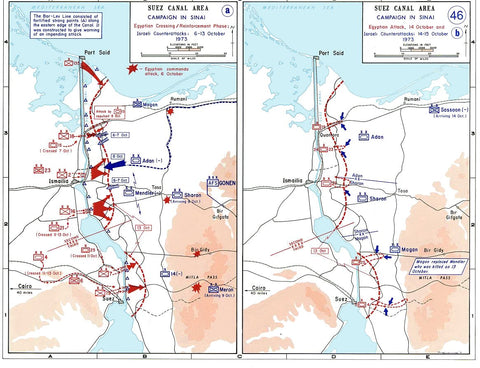
An example of using military symbology (Yom Kippur War - 1973)

Yom Kippur War 1973 Applied Military Symbology

 A PRIORITY NO IN APPLICATION FOR THE CONSTITUTION OF A CITIZEN MILITIA. AND YET, IF ONE BASES ONESELF ON THE SAME SYMBOLOGY TO IDENTIFY ONE'S OWN MEANS, THE ARTICULATION OF THE UNITS IN OPERATION (EVEN IF IT IS A BINOMIAL) AND THE ENEMY CAPACITY... THE CAPACITY OF PLANNING AND CHOICE OF ACTIONS IS MUCH BETTER!


Stay strong, be blessed!

Knife Fighting - Basics

Your body is a machine. A machine made of flesh, bones, organs that allow it to function, a feeding system to "feed" it - the blood system - and a transmission system to coordinate everything from the brain (the nervous system). Of course this is a schematic (any doctor would present the body in a more detailed way), but it will allow us to establish a basic premise: any significant damage to this complex machine jeopardizes its ability to function, even prevents it from continuing and can lead to death. The human being, as the biggest predator on our planet, is perfectly aware of this fragility and has never lacked imagination to develop a means of attacking or defending himself, from the good old club to the inter-continental missile. But there is ONE weapon that has crossed the ages, the fashions, the technological evolutions without ever losing its usefulness in the eyes of our species: THE KNIFE. In various forms, swords, daggers, daggers, folding knives, from flint to the latest carbon steels, it is used everywhere and remains an indispensable defense tool (we'll talk about mushroom picking and sushi cutting another day, eh?) and deadly - in a hand-to-hand combat situation.

To be convinced of this, just use your kitchen knife to cut out your steak or any piece of meat. Did you see how sharp a sharp knife is? Just imagine that a human body is made up of the same structure to immediately understand how a knife thought and intended for combat is a terrifying weapon. Terrifying for the one in front, but especially for you if you do not know how to use it!

A knife really does damage? (go directly to 1m07s):

 Do you understand the principle? Perfect! In two words: you won't get out of a knife fight unscathed. Whether you're a martial artist, 2 meters and 100 kg, if your opponent (or opponents) touch you with a blade (EVEN IF THE BLADE IS NOT WOUNDED WITH MUCH POWER) you will be immediately injured, potentially very seriously.

Some statistics (Professor Boxho - Institute of Forensic Medicine of Liège):

  • 30% of people who have suffered a knife attack die (against 10% for those affected by a bullet)
  • 80% of people affected by a knife (thrusting) did not notice it - they thought of a simple punch - it is the presence of blood that gives the alert

People who are armed on a daily basis (with a handgun or rifle - police and military) believe that the safe distance to the knife carrier before shooting him/her is 25 meters. Why is this? Because the inertia of a moving human body (of a man of 70Kg for example) will be sufficient to reach you, even if shot.

 Now that it is well understood that to fight with bare hands against an opponent armed with a knife is simply suicide, it is a question of choosing the ideal knife to accompany you in your daily life, to be used for your defense but not only (to prepare a sandwich, to tinker with the children's cabin...). It must have several advantages:

  • Be easily transportable without risk for you
  • The handle of your knife is adapted to the morphology of your hand (its size is the same as the width of your four fingers together)
  • The blade is (ideally but always with what we have) adapted to your fighting style (Bowie, Karambit ...)
  • Obviously if it is maintained and sharpened!

Once you have chosen the knife of your dreams and (I'm not going to dissert on the subject, but it's important) that you have made the psychological step to allow you to carry it on a daily basis, you MUST learn the basic movements to familiarize yourself with the sensation of the knife in your hand and avoid injuring yourself or someone else unintentionally:

  • Drawing/Sheathing
  • Opening / Closing (in the case of a folding knife)

To begin training, a safe and effective method is to use a felt pen (instead of a knife) against an opponent who is also equipped with a felt pen of another color.) After an exchange of blows, count the number of marks on your respective bodies...and you will quickly understand that it is far from being won!

There is no "correct" way to wield a knife, except your own. You will have to find the position that is naturally familiar to you, the one you are most comfortable with. On the other hand, HOLDING your knife correctly is essential! Your hand must be at one with the handle and leave as little opening as possible for an opponent who wants to disarm you. The simplest grip (and therefore THE ONE TO ADOPT IF YOU DON'T KNOW ANY OTHER WAY) is called the "hammer grip" - your hand is completely wrapped around the handle, and your thumb is also positioned around the handle (like when you use a hammer). This grip has the advantage of optimal power when you make a thrust or a cut (from top to bottom), without having to be very technical. There are (depending on the fighting style, your technical level, the type of knife) a variety of grips. Just remember that the goal is to be effective and to SURVIVE, it is not a choreography.

We note that:

  • Your blade is ALWAYS in front of you (and between you and your opponent), like a bulwark.
  • Keep your back to yourself, try to offer as little surface area as possible to your opponent's blade (pull in your shoulders and head, adopt a "fighting" posture).
  • ALWAYS stay in motion! You can move from right to left or from front to back but EXCLUSIVELY facing the opponent
  • Do not make large movements with your arms (at the risk of being injured by a blow from the waist) but limit them to the fastest trajectory (straight ahead).
  • Use your knife rather than your arm to parry the blow. A wound, even a superficial one, that bleeds profusely will be very disabling. A good knife fighter will parry THEN strike (in theory...in practice...come what may!)
  • It is very likely ( VERY CERTAIN ) that you will not be able to dodge all of your opponent's blows. Even if you keep your distance, even with a long knife. It is ESSENTIAL to preserve your organs and bloodstream. If you have no choice, use your arm to save your vital functions.
  • BEFORE YOU STRIKE:
    • Keep your distance (and stay in motion)
    • Observe your opponent and his reactions, his repeated movements, everything that can look like a “routine”
    • Observe (and where appropriate use) your environment
  • AT THE TIME TO STRIKE:
    • If you are in danger of death, strike as soon as the opportunity arises.
    • Remember that your stroke must be direct, straight to the target
    • At the moment of the blow, stop thinking and let your body take over.
    • Strike with as much power as possible, towards the neck or upper torso (heart and lungs) if possible

IF YOU DON'T LEAVE OTHER PEOPLE IN DANGER BEHIND YOU AND THE OPPORTUNITY ARISES, RUN AWAY! IT'S NOT ABOUT ACTING LIKE A FILTHY PUSSY BUT ABOUT STAYING ALIVE. AND THE ULTIMATE GOAL IN THIS CASE IS TO SURVIVE!

To go further : contact me, I will send you a list of books, websites, methods...


Stay strong, be blessed!